
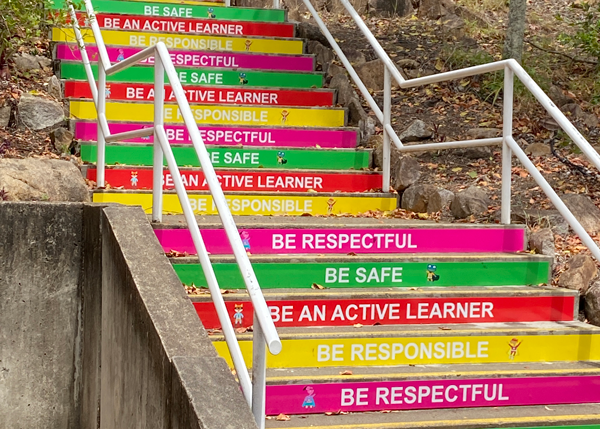
Most schools can clearly articulate their values.
They are written in strategic plans, student diaries, websites, and enrolment packs. They are talked about in assemblies and staff meetings.
But values only start to shape behaviour when they are visible in the everyday environment.
That is where signage plays a powerful role.
Values Are Learned Through Experience
Students do not engage with values as abstract ideas.
They experience them through daily interactions, routines, and spaces. The physical environment of a school reinforces what matters long before a lesson begins.
When values are visible around the school, they become part of the culture rather than just words on a page.
Seen consistently, values feel lived rather than stated.
Visibility Reinforces Belonging
Clear, well-designed values signage helps students understand what a school stands for.
It signals that values are not an add-on. They are central to the school’s identity.
When values are embedded visually across classrooms, corridors, and shared spaces, they help:
- Create a sense of belonging
- Reinforce shared expectations
- Support positive behaviour
- Build pride in the school community
This visibility supports students, staff, and families alike.

Age-Appropriate Design Matters
For values signage to be effective, it must be designed with students in mind.
What resonates with a prep student is very different to what connects with a senior student. Language, colour, imagery, and scale all influence engagement.
Effective school values signage:
- Uses language students can understand
- Reflects the tone of the school community
- Feels appropriate to the age group
- Is clear without being patronising
When students can relate to what they see, values feel relevant rather than imposed.
Placement Is as Important as Design
Values signage works best when it is placed where learning and interaction happen.
Hallways, learning spaces, libraries, and common areas all offer opportunities to reinforce messages naturally. When signage is placed thoughtfully, it becomes part of the rhythm of the school day.
Scattered or inconsistent placement reduces impact. Intentional placement strengthens it.
Values Should Feel Integrated, Not Decorative
Values signage is most effective when it feels connected to the school’s identity and learning environment. Consistent colours, typography, and tone help values signage feel intentional rather than decorative.
This consistency reinforces credibility and helps values feel embedded rather than bolted on.
When Values Are Only Written Down
When values exist only in documents, they are easy to overlook.
Students may be able to recite them, but that does not mean they influence behaviour. Visual reinforcement helps bridge the gap between knowing and doing.
Seeing values daily helps normalise them. Over time, they become part of how the school operates.
Final Thought
School values are not just statements. They are standards the school lives by.
When values are visible in the environment, they move from abstract ideas to everyday reference points. They support culture, behaviour, and belonging without needing constant explanation.
Values that are seen are far more likely to be remembered. And values that are remembered are far more likely to be lived.