
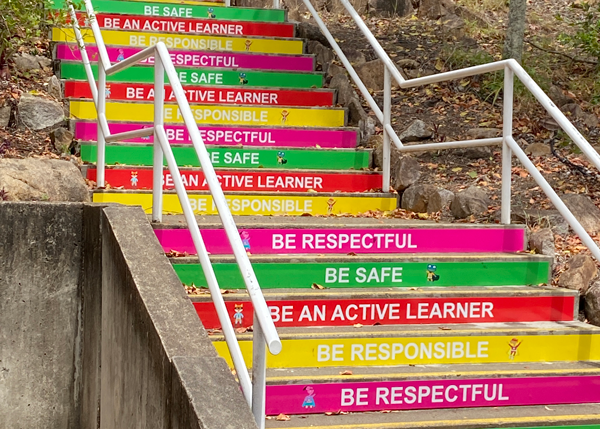
Why Action-Based Values Make the Difference
Most schools have a clear set of values. Respect. Integrity. Responsibility. Excellence.
They sit proudly in strategic plans and feature in enrolment packs. They’re referenced at assemblies and displayed in reception areas. And they matter.
But here’s the question worth asking.
Are they shaping behaviour in classrooms and playgrounds every day?
Because there’s a gap between stating values and embedding them. If the goal is genuine behaviour change, the language we choose plays a critical role.
Why Nouns Fall Short
Values are often written as nouns. Respect. Responsibility. Integrity.
They’re strong concepts. But they’re also open to interpretation.
What does “respect” look like during group work? What does “responsibility” look like when a student forgets homework? Ask five staff members and you may get five slightly different answers.
Students, particularly younger ones, don’t respond to abstract concepts. They respond to clear expectations.
That’s where verbs make a difference.
Turn Values into Action
A simple shift can create clarity.
- Instead of “Respect,” use Be Respectful.
- Instead of “Responsibility,” use Take Responsibility.
- Instead of “Integrity,” use Act with Integrity.
- Instead of “Excellence,” use Strive for Excellence.
It’s a small grammatical change. But it reframes the value as something active. Observable. Teachable.
Under each action-based value, you can define what it looks like in practice.
For example:
Be Respectful
- Speak kindly to others
- Listen when someone else is talking
- Care for shared spaces
- Follow staff instructions
Take Responsibility
- Own your actions
- Bring required materials
- Complete tasks on time
- Make things right when you make a mistake
Act with Integrity
- Tell the truth
- Do the right thing even when no one is watching
- Honour commitments
Strive for Excellence
- Give your best effort
- Set goals and work towards them
- Seek feedback and improve
Now the value is no longer abstract. It becomes behavioural.
Teachers can reference it in real time. Students can reflect on it. Leadership can reinforce it consistently.

Developmentally Relevant, School-Wide Consistency
One of the strengths of action-based values is that they can scale across year levels while remaining consistent.
The heading stays the same. The examples evolve.
In a primary setting, “Be Respectful” might include keeping hands and feet to yourself or sharing equipment. In a secondary setting, it may extend to engaging thoughtfully in discussion or representing the school appropriately online.
The framework remains cohesive. The application becomes age-appropriate.
That consistency across the campus builds a shared language. Over time, that shared language builds culture.
Visibility Supports Behaviour
Language alone is not enough. The way values are presented across the school environment reinforces their importance.
When action-based values are visible in classrooms, corridors, learning spaces and assemblies, they become reference points. They move from policy into daily practice.
A teacher can ask, “What would taking responsibility look like right now?”
A student can identify how they are striving for excellence in their work.
That shift from concept to conversation is where behaviour change begins.
From Words to Culture
If school values are going to influence behaviour, they need to be clear, consistent and actionable.
Framing them as verbs does more than tidy up language. It makes expectations visible. It reduces ambiguity. It supports restorative conversations and positive reinforcement.
Most importantly, it gives students something they can actually do.
If you’re reviewing your school values and want to strengthen their impact across your campus, it may be time to revisit the language. Small shifts can create significant cultural change.