

I recently visited a local school to quote on some new signage.
As usual, I parked the car, grabbed what I needed and went looking for the office. Simple enough, you would think.
Except it very quickly became obvious why they needed signage.
The wayfinding was almost non-existent. No clear office sign. No helpful arrows. No “You Are Here” maps. So I did what most people do when there is no direction.
I guessed.
Bold move.
I headed in the general direction that felt office-ish and somehow ended up at the tuck shop.
At this point, a small child whispered something to her friend, looked back at me with deep suspicion, then cautiously approached.
“Excuse me, sir…” she said quietly.
I leaned down, relieved. Surely she could tell I was lost. Maybe she was about to point me towards the office. Maybe this was one of those lovely moments where a helpful student saves the day.
“Excuse me, sir,” she muttered, “are you here to kill people?”
Right.
At that point, I decided that guessing had run its course.
I asked the tuck shop lady where the office was and made my way there as quickly as possible.
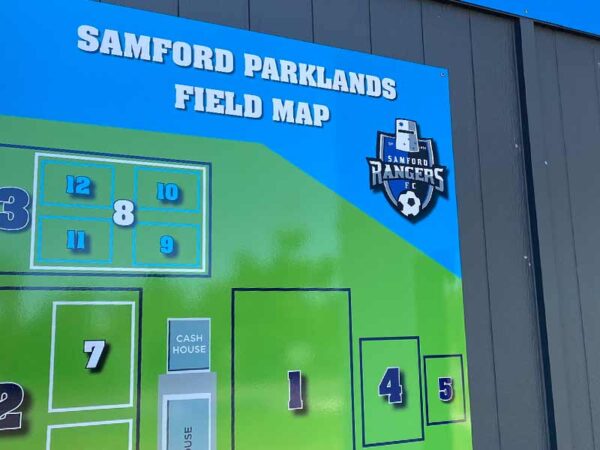
Why you need good wayfinding signs
Good wayfinding is not just about convenience. It helps visitors feel like they are in the right place, and helps everyone else feel like the random adult wandering around campus probably has a legitimate reason to be there.
That is the thing about poor wayfinding. It does not just make people lost. It makes them feel awkward. Like they have missed something obvious. Like they are standing somewhere they should not be.
Good wayfinding does the opposite. It quietly says, “You are in the right place. Here is where to go next.”
And that is really the art of not making visitors feel stupid.
Nobody likes feeling lost in public
Good wayfinding is one of those things people rarely praise.
Nobody walks into a school, clinic, office, site or facility, finds reception easily and says, “Wow. What a beautifully logical journey that was.”
They just arrive. Calm. On time. Not annoyed. Not wandering into the wrong area. Not asking the tuck shop lady for emergency directional support.
That is the quiet magic of good wayfinding. When it works, it disappears into the experience.
When it fails, everyone notices.
Why good wayfinding matters
Good wayfinding is not just about arrows on walls. It shapes how people feel in your space.
When signage is clear, visitors arrive calmer. They know where to park, where to enter and where to go next. They do not have to wander, guess or interrupt staff just to find reception.
Poor wayfinding creates friction. People arrive late, walk into the wrong area, ask the same questions over and over, or feel like they have missed something obvious.
That is not the first impression you want.
The best signs answer questions early
A strong wayfinding system gives people the right information before they need to ask for it.
That might include:
- Entry and reception signs
- Parking and access signs
- Directional signs at key decision points
- Room names and numbers
- Lift, stair and amenities signs
- Safety and restricted area signs
- Site maps for larger facilities
The key is placement. Signs need to appear where people make decisions, not after they have already gone the wrong way.
A sign placed after someone has already made the wrong turn is not wayfinding. It is a polite little taunt.
Consistency builds trust
A wayfinding system should feel like a system.
If one sign says “Reception”, another says “Front Office” and another says “Admin”, people start second-guessing.
Use the same names, arrows, colours, icons and hierarchy throughout the site. The more consistent the signage, the more confident people feel using it.
When signs feel random, visitors stop trusting them. They pause, backtrack, ask staff, or wander into places they were never meant to be.
Not ideal.
Wayfinding is part of your brand
Wayfinding is often treated like an afterthought.
A printed A4 sheet taped to a wall. A temporary sign that has been temporary since 2021. A handwritten arrow because “people keep getting lost”.
We have all seen it.
The problem is, those signs still represent your business. They tell people whether your space feels organised, professional and considered.
Brand Hero PNG supports organisations with signage, print and design that creates consistency at every touchpoint and helps businesses present a professional image to their audiences. Wayfinding fits neatly into that. It is not just about directions. It is about making the whole place feel easier, calmer and more put together.
Bigger spaces need a proper system
Schools, hospitals, offices, mining sites, government buildings, industrial facilities and multi-building campuses need more than a few random arrows.
Larger spaces need signage that considers:
- How people arrive
- Where they park
- What they see first
- Which areas are public or restricted
- How visitors and staff move differently
- Where safety information is needed
- How signs work with the brand and site environment
Good wayfinding is planned from the visitor’s point of view, not from the desk of someone who already knows the building backwards.
That distinction matters.
A quick wayfinding check
Walk through your site like you have never been there before.
Better yet, ask someone who genuinely has not been there before.
Start from the road or car park and ask:
- Is the entrance obvious?
- Can visitors find reception without asking?
- Are signs placed before decision points?
- Are room names consistent?
- Is the text readable from a useful distance?
- Are restricted areas clearly marked?
- Are temporary signs doing permanent work?
- Does the signage feel professional?
The weak spots are usually where people pause, hesitate, backtrack or ask for help.
That pause is the clue.
Final thought
Good wayfinding is really an act of hospitality.
It helps people arrive without stress, move through your space confidently and feel like they belong there.
When signage works, people feel looked after. When it does not, confusion becomes part of their experience.
Your signs may be quiet, but they are always communicating.
Make sure they are saying, “You are in the right place. Here is where to go next.”
Need better wayfinding signage?
If visitors, staff or contractors keep asking where to go, your signage might be working harder than it should.
Brand Hero can help you plan, design and produce clear, professional wayfinding signage that makes your space easier to navigate and better to experience.