
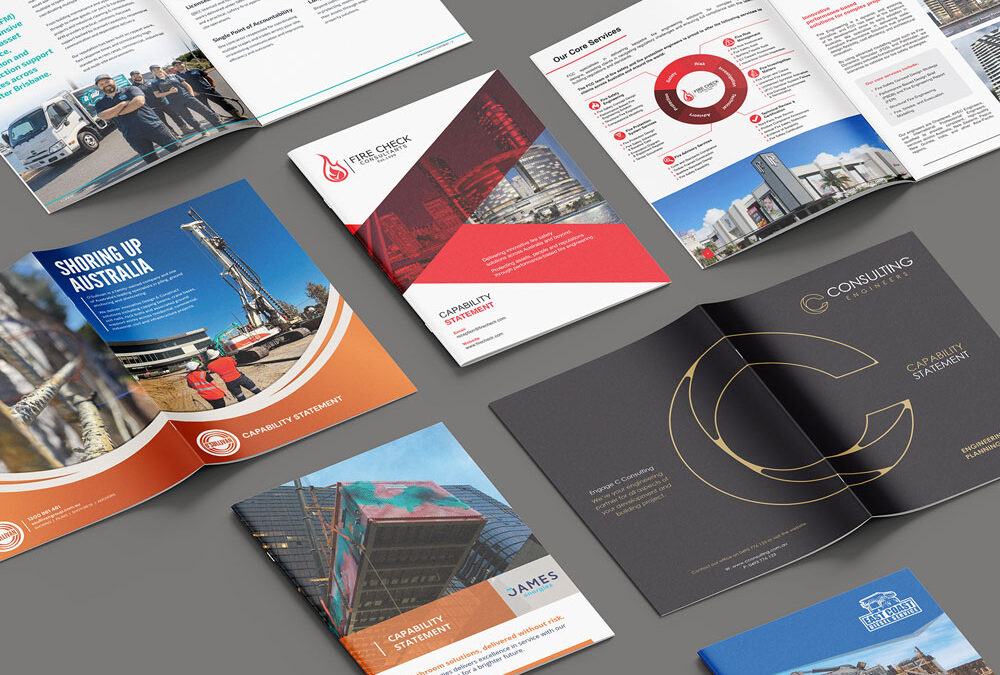
A capability statement is one of those documents that seems simple until you actually try to make one work.
On paper, it is just a few pages about your business.
In reality, it has a much bigger job.
It needs to quickly explain who you are, what you do, who you work with, why you are credible and whether you are worth a closer look.
And it usually has to do all of that while someone is flicking through it at speed, probably between three other documents and a coffee.
That is why the strongest capability statements are not simply information dumps. They are structured to make your business easy to understand and easy to trust.
1. A clear opening
The first page needs to answer a basic question quickly:
Who are you and what do you actually do?
Avoid vague statements that could belong to any business. Your opening should give the reader enough context to understand your company, your market and the kind of work you are suited to.
A good introduction is short, confident and specific.
If someone has to read three paragraphs before they know what you do, you have already made their job harder.
2. Your core capabilities
This is the heart of the document.
Your key services or capabilities should be easy to scan and grouped logically. Do not bury them inside long paragraphs or list every single thing you have ever done.
Focus on the work you want more of.
For example, if you are targeting larger commercial or government opportunities, lead with the capabilities that matter most to those buyers.
A capability statement is not the place to give equal billing to every service just because you technically offer it.
3. Proof that you can actually deliver
Anyone can say they are experienced.
The stronger question is: what can you show?
That proof might include:
- major clients
- relevant projects
- years of experience
- industry accreditations
- licences and certifications
- geographic coverage
- team expertise
- project values
- safety systems
- measurable outcomes
The goal is not to brag. It is to reduce uncertainty.
If someone is considering trusting you with a large contract, they want evidence that you can handle it.
4. Relevant project experience
A good project example is worth far more than a page full of generic claims.
Keep case studies short and useful. Explain the client, the challenge, what you delivered and the outcome.
Most importantly, choose examples that relate to the kind of work you are trying to win.
If you want mining work, show mining experience.
If you want government work, show government experience.
If you want large corporate projects, show that you understand the scale, governance and expectations that come with them.
Relevance beats volume.
5. Your points of difference
This section is often handled badly.
A lot of capability statements fall back on phrases like “quality service”, “experienced team” and “competitive pricing”.
The problem is that nearly every competitor is saying exactly the same thing.
A useful point of difference should help the buyer understand why working with you is different.
Maybe you have local capability backed by national resources.
Maybe your turnaround times are unusually strong.
Perhaps you have experience operating in remote locations, strict safety environments or complex stakeholder settings.
Whatever it is, make it specific and believable.
6. Safety, compliance and credentials
For many industries, particularly government, mining, construction and resources, this is not optional.
Buyers may want to know about your safety systems, insurances, licences, certifications, policies, Indigenous participation, environmental commitments or other compliance requirements.
Do not make them hunt for it.
If these things matter to your target market, give them a clear place in the document.
It sends an important message: you understand how their world works.
7. Strong visual presentation
A capability statement is not a brochure, but it still needs to look good.
Good design helps people understand information quickly.
That means clear headings, strong hierarchy, useful white space, consistent colours, good photography and pages that do not feel overcrowded.
It should also feel unmistakably like your business.
If your website, signage, uniforms and capability statement all look like they belong to different companies, that inconsistency chips away at trust.
Presentation will not win a contract on its own, but poor presentation can certainly make a strong business look weaker than it really is.
8. Make it easy to scan
This is one of the most important points.
Most people will not sit down and lovingly read your capability statement from front to back.
They will scan it.
That means the document should still make sense if someone only reads the headings, captions, key statistics and highlighted information.
Short paragraphs are useful. So are bullet points, icons and project snapshots.
The trick is to make it easy to skim without making it feel shallow.
9. Make the next step obvious
It sounds simple, but capability statements often forget this.
What do you want the reader to do next?
Call you?
Email you?
Visit your website?
Request a meeting?
Make sure the contact details are easy to find and the next action is clear.
Do not make someone work to figure out how to get in touch.
The biggest mistake? Making it all about you
This is where many capability statements lose their way.
They become a history of the company.
When you started.
How many years you have been operating.
How proud you are of the team.
Where the founder came from.
Some of that can be useful, but only if it helps the buyer make a decision.
A winning capability statement is really about answering the questions in the buyer’s head:
Can these people do the job?
Can I trust them?
Do they understand our industry?
That is the real anatomy of a strong capability statement.
It is not about packing in more information.
It is about giving the right information, in the right order, so the reader quickly understands why your business deserves to be considered.
Need to sharpen your capability statement?
At Brand Hero, we help businesses turn messy, outdated or overly wordy capability statements into clear, credible sales documents that are easier to read and easier to trust.
Because a capability statement should not simply explain what you do.
It should help you win the next conversation.