
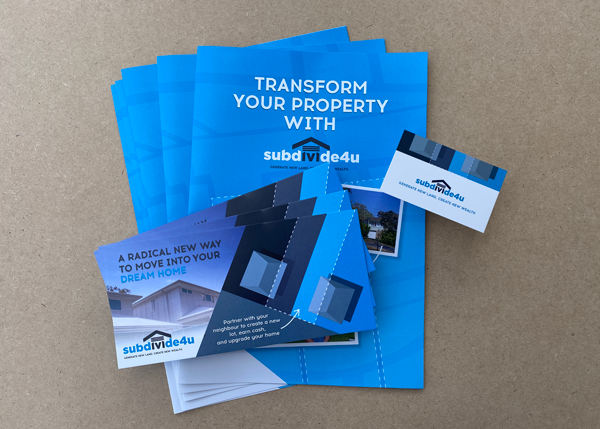
Ever held a really nice business card in your hand? Maybe I’m a geek, but this is the kind of thing I notice. There is something oddly satisfying about holding it.
You notice the weight.
The texture.
The finish.
That might sound a little dramatic for a piece of paper, but physical marketing materials do something digital content often struggles to do.
They feel real.
And in these days of AI bots, deepfakes and Donald Trump’s hairpiece, real matters.
Print creates a different kind of attention
Digital marketing is quick.
We scroll, skim, click, close tabs and move on.
Printed material tends to slow people down.
A brochure on a desk or a capability statement handed across a meeting table creates a moment of attention that feels more deliberate.
People are not just looking at the information. They are physically interacting with it.
That can make the experience feel more considered and memorable.
Touch influences perception
We make judgements through our senses all the time.
A heavy business card can feel more substantial.
A soft-touch finish can feel more premium.
A flimsy flyer printed on cheap stock can make a business feel less polished than it probably is.
None of those reactions are entirely rational, but branding rarely is.
People often use small visual and physical cues to decide whether a business feels credible, established or worth paying attention to.
The stock, finish and production quality become part of the message.
Good print can build trust
Imagine you are meeting two companies.
One hands you a clear, well-designed capability statement with strong photography, useful information and a professional finish.
The other emails you a cluttered PDF afterwards.
Both businesses might be equally capable.
But they do not necessarily feel equally capable.
That is the interesting thing about presentation. It shapes expectation before the work even begins.
Print can give a business a sense of permanence and confidence that is harder to achieve through a screen alone.
It helps people remember you
Most marketing is fighting for memory.
You want someone to remember your name, recognise your colours and think of you when they eventually need the service.
Printed materials can help because they create another physical touchpoint.
A brochure might sit on a desk.
A business card might stay in a wallet.
A capability statement might get passed around internally.
A branded folder might remain in a meeting room long after you have left.
That gives your brand more chances to be seen again.
Print works especially well in face-to-face sales
There is still a strong place for printed material in meetings, events, trade shows and sales presentations.
A good printed piece gives people something to look at while you talk.
It can help structure the conversation, reinforce key points and make it easier for someone to take the information away afterwards.
This is particularly useful when you are selling something complex.
Instead of trying to explain every service verbally, the printed material can support you.
It becomes part of the sales process rather than just something to hand out at the end.
People judge quality by the details
This is where businesses sometimes undermine themselves.
They spend heavily on their website, signage and uniforms, then print brochures on cheap paper with weak images and inconsistent branding.
The materials do not match.
That inconsistency creates friction.
If your business wants to look established, premium or highly capable, the physical materials need to support that impression.
Otherwise, the customer notices the gap, even if they cannot quite explain why.
Design still matters more than fancy finishes
It is easy to get carried away with print options.
Foil.
Spot UV.
Embossing.
Specialty stocks.
Fancy folds.
These can all work, but only if the basics are right first.
A beautifully finished brochure with poor copy and cluttered design is still a poor brochure.
The strongest printed materials usually have:
- a clear purpose
- strong hierarchy
- easy-to-read copy
- good photography
- consistent branding
- a logical flow
- one obvious next action
The print finish should support the message, not become the message.
Print can make your business feel more considered
This is probably the biggest psychological advantage.
A good printed piece feels intentional.
Someone has taken the time to design it properly, choose the right stock, produce it well and put it into your hands.
That effort communicates something.
It says the business cares about presentation.
It says the details matter.
And for many customers, that becomes a clue about how the business might approach the actual work.
Digital and print work better together
This is not an argument for replacing digital marketing.
Quite the opposite.
The best results often come from using both.
A printed capability statement can lead someone to your website.
A brochure can include a QR code linking to a project gallery.
A business card can reinforce the same branding someone has already seen online.
The psychology becomes stronger when every touchpoint feels connected.
The customer sees the same colours, the same tone and the same level of professionalism wherever they encounter the brand.
That consistency builds familiarity.
And familiarity builds trust.
So does print still matter?
Absolutely.
Not because paper is nostalgic.
Because physical marketing can create attention, reinforce quality and make a business easier to remember.
The key is making sure the material earns its place.
If you are going to put something in someone’s hand, make it useful.
Make it clear.
Make it feel like your business.
And make it good enough that they do not immediately throw it in the recycling bin.
Need printed materials that actually support your brand?
Brand Hero helps businesses create brochures, capability statements, presentation folders, business cards and other printed marketing materials that look consistent, feel professional and make a stronger impression in sales conversations.
Because print should not just look nice.
It should help people trust you, remember you and take the next step.